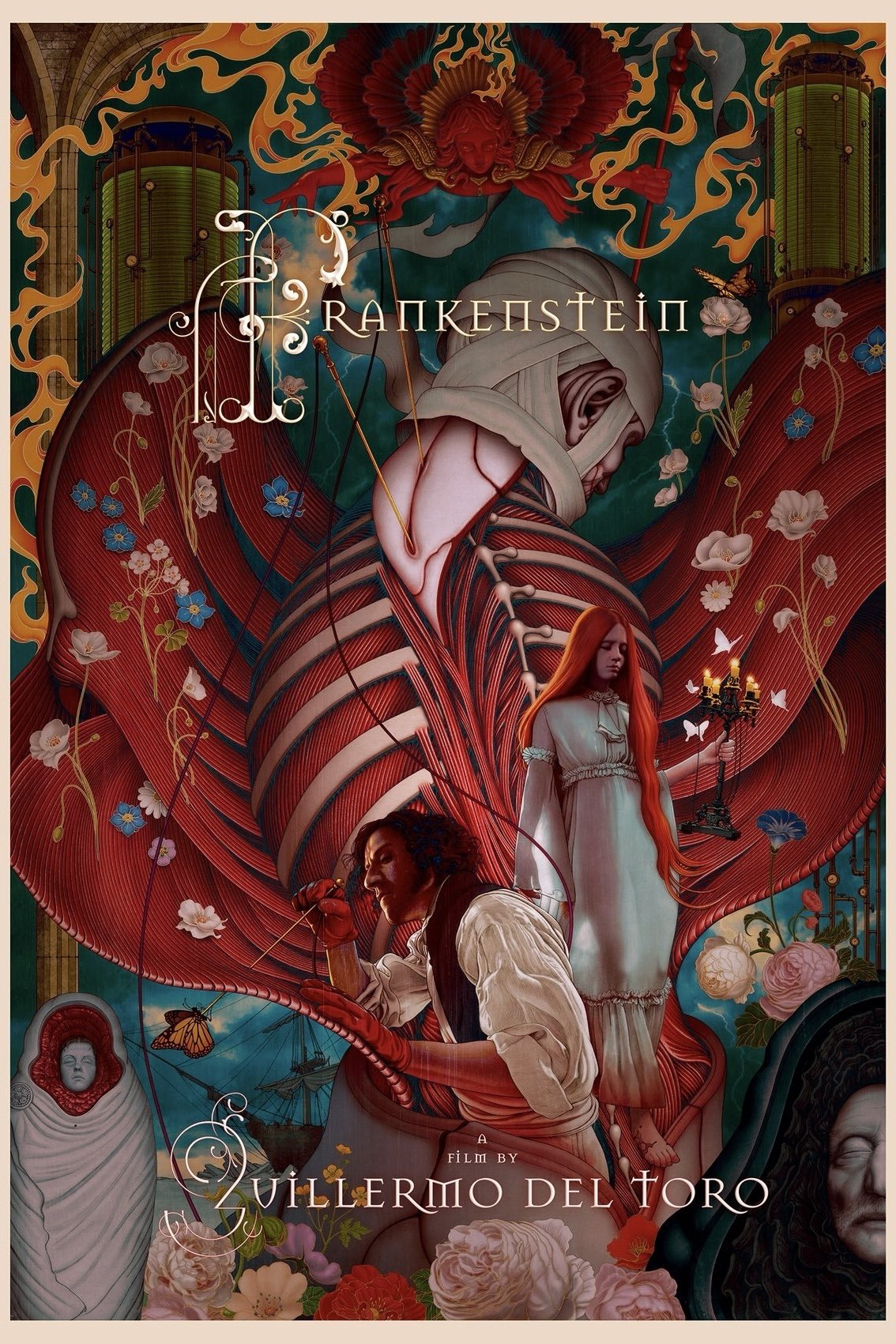
We watched this with our buds over and I had a lot of fun.
- Making fun of Victor Frankenstein became a passion.
- Feeling bad for the Creature and wishing him well also became a passion.
- Tragic but beautiful.
The color symbolism for this movie is on POINT, alongside small certain symbols that are easy to latch onto.
Victor Frankenstein is a cuck who holds passion for his mother. The symbolism of passion— traditional red— is overlapped with loss, obsession, trauma, and mourning. White, obviously, is the purity symbol, and often shown in loose, flowing, wavy accoutrements. You can watch Victor transform from pure (wearing exclusively white) and the moment he is marred forever by the trauma of his mother passing (the red, which he wears forever, and then wears red gloves to show the metaphorical blood on his hands).


Victor’s subtle mommy cues add up in the ivory anatomy doll he plays with throughout the movie and the literal actual MILK he ingests. Constantly. Even when others are drinking wine (could be interpreted as blood as well— each person drinking wine has died tragically). The black he wears is from his father and the mourning he never leaves behind.


Meanwhile, you have blue and gold: blue for a subtle sadness, relaxing, almost royal tinge. Gold for generosity. It’s no coincidence that William and Herr Harlander are done up in blue and gold much of the time. William is all about it and end up in more and more gold until the tinge of green begins to slip into his generous nature. For our financier, the blue begins to fade and his clothing grows darker over time, while the gold remains. Both are generous in different ways: Herr Harlander with his money, William with his time and energy. William soon transitions to white to show a purity of spirit as well during his wedding, remaining unmarred for his death.


Elizabeth’s red hair is unmistakable in the movie: the passions of the men, the tragedy of her character. She often wears blue and green, blue transitioning to the green as Victor grows fonder of her. While she is unreachable, she wears blue. When they become closer, green. There is the obvious symbolism (envy), and then there is the idea of poison.


Here is where I refer to malachite being her patterning. Malachite is toxic when broken down or ground into dust. It is safe to handle in most setting, but one must still know how to care for it so that they might not hurt themself. Notice, too, the red rosary: a transference of Victor’s worship.
Moving on, here’s a shitload of other symbols:


The apple passed to the artificial man, passing knowledge. The red around his neck, a noose of trauma. The red symbolism is hard to miss here. Also, love the lighting.

This man be living in darkness, surrounded by the passion inspired by his trauma in the same environment he was raised by his father in. Note the milk in his hand.

This is the memento mori portrait scene. Note the red and the ivory women in the background, while the woman in the foreground gazes into the camera. As she resembles superficially the Frankenstein mother, one can imagine that she is leering at the audience. Her hair is wreathed in gold much like the angel that Victor worships, and it is literally said in the film that the peach is a symbol of life and youth. It is eaten before the audience.

This is Elizabeth’s first appearance, as a foil to the image of the Frankenstein mother. She holds a skull, most obviously symbolizing death in opposition to the peach. Foreshadowing. The blue is her tragic nature, but also an unreachable creature who stands out from the trauma. Note the ivory women are removed from the setting, just out of frame. Her headdress is intended to be much like a bug, and the ethereal wing-like nature of her dress may describe her as the butterflies that appear later in the film. The flowers at present are life and beauty of character.

MILK (and him being cast in darkness vs the light at the other end of the table)


The red of the umbrella is Victor’s misplaced passions. Note also the gold bonnet: she will be generous with her listening and mind. The blue shawl is a nod to the unreachable nature, while the patterning embraces a butterfly-wing like motif. Note now her dress is green. She is “lighting up” the darkness as well.


More: she is light, and he is in darkness.

Note her lacing here. The spine in the movie is the key to bringing a corpse to life.


Here we introduce firmly the butterfly symbolism. It is ethereal and delicate, trapped now in a cage.
I can go on and on and on but this is quite a long movie. I believe though I’ve gotten my point across, and it’s well worth a rewatch. And another, and another… I just don’t wanna write anymore. I haven’t even touched on the fire being now more than a symbol of fear, but of destruction of the self, a cleansing.