
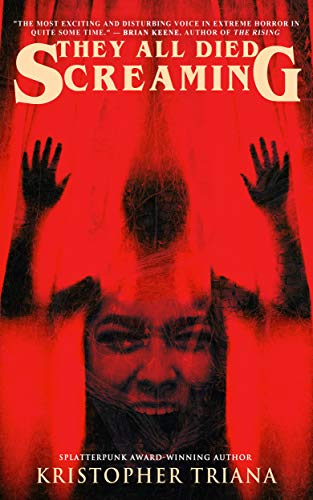
It’s called The Scream…
Once you get it, you simply cannot stop screaming.
You can’t eat or sleep. It drives you more and more insane until you can’t stand to be alive a second longer.
When the phenomenon hits Chuck’s city, the chronically unemployed pervert joins a band of misfits to make his final stand.
Can Chuck, a bitter bartender, a dockside prostitute, a conspiracy theorist, and a homeless man find a way out of the apocalypse…
Or will they all die screaming?
They All Died Screaming is a plague novel by Splatterpunk Award-Winning author Kristopher Triana. It is a pitch black book about the lowly and downtrodden being the last people on earth.
How funny is it that such a gross book, filled with rape and scumbags, is more diverse and tolerant of queer folks than a bunch of others? And it doesn’t hit the diversity checklist trope?
Granted, it was meant to be gross. It’s splatterpunk.
I’m not using the smut stuff listing since that’s for categorizing actual porn, but this is more like, sex as a device for character development. But here:
Sex Stuff:
Sexual Slavery, Bestiality, Fisting, Grease+Food, Group Sex, Oral, Anal, Filth, Rimming, Sex Work, Noncon, Underage, Masturbation, Whatever the word is for stuffing an entire foot into a vagina
You know, not the beautiful sex but the filthy stuff. It hits my squick, but uh, again. Splatterpunk. Others I’ve read (see: Stab the Rabbit) have a try-hard feeling about it, but this is actually a fairly interesting book. It’s told from the perspective of an absolutely atrocious dude who hangs out with other atrocious folks. Everyone is nasty in their own way.
In broad strokes, it condemns the human race. Misanthropic characters with terrible philosophies point out the atrocities committed by humans: animal abuse, global warming, pumping chemicals into the environment, etc etc. Barman basically says that humans are a plague and nature is just taking its course before his actual morals come out during the overtaking of the Scream; Chuck bemoans his brokenness and does not actually give a shit about people; Eugene is a conspiracy theorist; Shitty is an alleyway guy; everyone is just out there, surviving, fucked up, but alive.
And then it takes this microcosm of humanity, some of the worst it has, and zooms in. It condemns the treatment of women as nothing more than meat, a means to an end (further expounded by the simultaneous story about the veal), and as something less than human. The men are predators of women, each dealing in their own way:
- The man. Most of the book he has no name, and neither does “the boy”. He is a literal predator, hunting women and taking them to be used as meat. He devised a method to keep and process women, referring to them as veal. He holds sympathy for animals, maintaining a “romantic relationship” with a pig named Polly. He has a twisted kindness in him, one which was focused solely on the only other person (whom he considered a person), where he raised the boy as his son after the initial kidnapping. He loves his pigs, treats them as family, as more human than the “veal” he uses for money.
- Barman was a former rapist who tries to atone by defending women now, refusing to have a real name or identity, who can’t deal with the guilt of sex and unable to feel desire anymore because “My orgasm was more important than her life.” His story points out the hopelessness of victims in reporting, living the fact that he can walk free with no consequences, and punishing himself accordingly. Living by this philosophy, he dies protecting women but feeling as if he hasn’t atoned enough for his sins. Barman is the picture of atonement, growing accepting and protective.
- Eugene is always trying to talk over everyone, seeing himself as the lone protector of his family. Namely, his mother, who he sponges off of. He sees women with active sex lives as walking STD factories, full of filth. Through his conspiracies, he manufactures a reason to rape Brittany, necessitating Barman stepping in to defend the girl and remove her from danger. Eugene dies attempting to rape Leslie and use her body to “dump” his potential for the Scream. Eugene shows the justification, however absolutely fucked up, of abusing women.
- Shitty struggles with being seen as human himself, but as one of the downtrodden, all he’s in it for is the alcohol. He has the potential, but not the ability.
- Chuck. The book is from his perspective, and he views humanity as lesser, and has trouble caring for others. In his youth, he was taught to see women as less-than, using a literal approach to the passing on of masculine tradition and ideals that treat women as nothing more than… veal. Meat. A product to be used. He does not see his past actions as wrong, and while he has moved past literally using women as product, he still partakes in the use of women through sex, whether paid for or tempted. He most values women toward the end of the book, during the Scream, thanks to Leslie’s influence— but this also points out the way many men only care about women in relation to themselves, the old, “Don’t you have mothers, daughters, sisters? Wouldn’t you care if this happened to them?”
- Even a fucking male baby. Keisha’s son turns and attacks his sister in the crib. Chuck observes and does a mercy killing, noting “Yet another male abusing females.”
So my argument is that this book is less about the disease and more about the treatment of women. It’s using the Scream to pressure people to act as their true selves, to show all the worst parts of them. The women are actually well-written, more than cardboard cutouts to use. They struggle in this weird world, as bad as the men and yet still stepping stones for them. They’re characters, but they’re still women. Irony and pain, bro.
- “The veal”. Nameless women treated as livestock. Chuck sees women first as veal before slowly seeing them as something to carefully approach, use as he sees fit, and then walk away from. He understands women as “liars and cheats”, creatures that exist only to hurt him. Treated correctly, he would gain access to their sex. They were killed pointlessly, to “save” animals, and ground into meat. It constructs the frame of the story, the sort of outlook that the reader has as well. They’re used as an allegorical device for how men are raised and conditioned to see women.
- Leslie. Chuck’s neighbor, she appears screaming at her ex-boyfriend in the very beginning of the book. She’s desperate to be filled literally, combining food and sex to try to fill her metaphorical hole. Chuck at first uses her for sex, enjoying her desperation and figuring that free sex was better than paid. Over time, it’s her suffering that enamors her to him: he sees her more as a person to be loyal to in his own twisted way because she is “broken” as he is. She is on the down and outs due to a rabbit hole of tragic missteps: her late husband was depressed, and so she sought fulfillment elsewhere. She was caught fucking a guy in a public restroom, got nailed as a sex offender, decided to come clean and had to face the consequences. Namely… her husband killed himself and their children. She tried to throw herself out of a window to die, unfortunately survived, and now lives among the roaches. While she justifies her time to herself, she also feels heavily everything around her and chases the bottle. It’s the fucked up part of her that Chuck likes. She ultimately becomes a victim of her own desires again when Angel turns with her fist up her ass, and she bleeds out while sitting with Chuck in her final moments, masquerading as something happy.
- Angel. A sex worker who comes along with the group to hide out in Leslie’s apartment. She declines to be used during tragedy until Chuck threatens to throw her out if she doesn’t comply with fulfilling Leslie’s final fantasy. She is reduced to a silent tool to be used, and the consequences of using her are clear nearly immediately.
- Keisha. A normal mom. She lives in these shitty apartments with her family, just an example of a normal person. Her husband is the first victim in the building, and she defends him, begging not to call the cops since it would ultimately doom him despite how he’s changed to take care of himself and his family. Her need to take care of her children moves the final act forward, and she behaves selflessly towards others.
- Brittany. Used by the narrative to display what Chuck feels is truly woman, what makes him go. He sees her as an object to crave and want, luring her closer to him because he wants to use her. She is the virginal beauty everyone sees as a personal symbol. Chuck sees her as veal at first, Barman sees her as someone to protect and atone towards, Eugene feels she is a tool, Leslie feels she is competition, and Keisha looks on her as a child. In the end, she asks Chuck to have sex with her so she doesn’t die a virgin, and reveals that she is trans. Chuck pauses, but proceeds, calling her more of a woman than many he’s fucked in the past. He has gentle, loving sex with her; he sees her more as a person because of her former masculinity.
- Keisha’s baby girl. Once Chuck is officially the last survivor, he takes her on, trying to figure out what to do. Imagine how she would live. And even now, he cannot see her as a future person. He feels it’s better to kill her in the end, because she will suffer, and because she could just become veal.
It’s a lot and a technically satisfying book. People into the genre will enjoy the filthy descriptions, the distant and familiar perspective of Chuck, and will be able to read between the lines of savagery here. What usually puts me off of splatterpunk is the fact that most of what I have read so far are focused on grossing out the reader instead of telling a real story. I don’t care about the story, and I grow to hate it because it is just trying to get me to look away. I call that lazy, childish, even. It’s a stage of writing that many writers grow out of sharing, like discovering that the ability to write means you can write anything you want. It’s the focus that makes the book, that makes a story. The goal for what I’ve read before is to make the reader look away or take offense, to only be consumed by people who feel like it makes them more if they can take sitting through nasty scenes. And sure. Not every story needs to say something. I just feel like some stories should be written so that people give a shit, to make the slog and offense worth it.
I feel like this one made it worth it. A writer should want people to force themselves to look. They should strive to make the story something that, while disgusting or cruel, makes a reader want to sit in the filth and see what happens. I sat through a lot reading this book and I came away with a good impression, where I said to Remy:

Instead of, potentially, what was the point of all that? Bro fucked a pig and for what? I felt like there was a point to it. My line was apparently cheese on a butthole.