
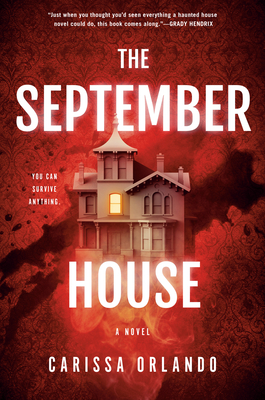
A woman is determined to stay in her dream home even after it becomes a haunted nightmare in this compulsively readable, twisty, and layered debut novel.
When Margaret and her husband Hal bought the large Victorian house on Hawthorn Street—for sale at a surprisingly reasonable price—they couldn’t believe they finally had a home of their own. Then they discovered the hauntings. Every September, the walls drip blood. The ghosts of former inhabitants appear, and all of them are terrified of something that lurks in the basement. Most people would flee.
Margaret is not most people.
Margaret is staying. It’s her house. But after four years Hal can’t take it anymore, and he leaves abruptly. Now, he’s not returning calls, and their daughter Katherine—who knows nothing about the hauntings—arrives, intent on looking for her missing father. To make things worse, September has just begun, and with every attempt Margaret and Katherine make at finding Hal, the hauntings grow more harrowing, because there are some secrets the house needs to keep.
I decided to give audiobooks another shot.
Seeing as I enjoy haunted house novels, I picked this one up to try since it touted itself as a horror-comedy. The concept is great!
And the book ended up being cathartic to listen to. I also caught myself crying a few times in the middle at the stark familiarity of some concepts and the dawning realization of the house’s allegory particulars. I really ended up liking Margaret’s personality— “Everything is survivable,” she says throughout the book as she constantly weathers an abusive relationship that forces her to isolate and invent rules to survive— since she is so very… strong.
Yes, she struggles, gods, she struggles! But she sees the worst and declares, well, it isn’t that bad. She’s just there, basically living out a “This is fine” meme.
“No one deserves to live like this.”
She’s pushed to the breaking point and she weathers it. She declares herself flexible, bending, and able to compromise. She considers herself strong because even her husband can’t manage the house. The husband who hurt her in the past. He can’t manage in the face of abuse, but she’s so used to it that it doesn’t faze her. Not one bit. She just carries on.
The ghosts are fascinating little stories in themselves. They’re parts of Margaret, in the allegorical sense: the beatings she’s endured lives in the children who simply watch and wander, pointing at the one who hurt them; the sense of betrayal by her husband lives in the woman from the fireplace; Edi is her desire to be a strong, matronly presence who brightens others’ lives; Frederica is her desire to be helpful, her desire to serve and be appreciated, the sense of duty she has despite the pain, and the forgetfulness that trails after her the entire time; Elias is her perception of her daughter and also her protectiveness over her daughter— he and his mother show the relationship she wishes to have and the one that remains, and it’s telling that Elias is the one who always fights first; the void is the emptiness in her life, literally just that; the blood! The blood is there to show how far Margaret is willing to go to ignore obvious pain and hurt, waiting for it to pass! The man in the closet is a remnant of the past of her trying to pull away and learning her lesson in being unable to leave! And Vale in the basement? A shadow of her husband.
And most notably is the absence of the ghost of her husband. He is personified by the evil in the basement, the one who exists solely to hurt until all the ghosts, symbols of her pain, demand that he leaves. Tells him he is no longer tolerated. Beats the ever living fuck out of him in cathartic revenge.
It’s beautiful.
And it’s so fucking funny. It’s such a fantastic way to depict such a relationship. The house is her, as most haunted houses are symbols of their occupants. But this one… she loves it dearly, and in the end as she heals it, it loves her back.