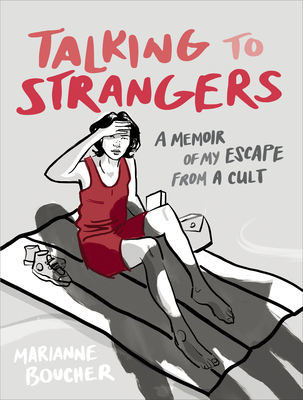
For fans of Wild Wild Country, Scientology and the Aftermath and Uncover: Escaping NXIVM, a spellbinding graphic memoir about a teenage girl who was lured into a cult and later fought to escape and reclaim her identity.
Welcome to a place where you are valued. Where everyone is kind. Where you can be your truest self.
It was the summer of 1980, and Marianne Boucher was ready to chase her figure skating dream. Fuelled by the desire to rise above her mundane high-school life, she sought a new adventure as a glamorous performer in L.A.
And then a chance encounter on a California beach introduced her to a new group of people. People who shared her distrust of the status quo. People who seemed to value authenticity and compassion above all else. And they liked her. Not Marianne the performer, but Marianne the person.
Soon, she’d abandoned school, her skating and, most dramatically, her family to live with her new friends and help them fulfill their mission of “saving the world.” She believed that no sacrifice was too great to be there—and to live with real purpose. They were helping people, and they cared about her . . . didn’t they?
Talking to Strangers is the true story of Marianne Boucher’s experiences in a cult, where she was subjected to sophisticated brainwashing techniques that took away her freedom, and took over her mind. Told in mesmerizing graphic memoir form, with vivid text and art alike, Marianne shares how she fell in with devotees of a frightening spiritual abuser, and how she eventually, painfully, pulled herself out.
I sat and thought about this one for a bit. The visual metaphors are on point, but the story is so personal that I fear that it may miss the point for some readers. Some readers won’t necessarily pick up on the love-bombing being literally shown because of the way it’s drawn, alongside the peer pressure points. A lot of the experience is shown in a metaphorical way, putting distance between the writer and the subject matter and therefore distancing the reader further.
I do like that it doesn’t dish out all the sordid details— not everyone experiences the “worst” parts of being in a cult, and sometimes it feels embellished. But it feels so far away.
Mostly we focus on the indoctrination and then the ensuing escape. I believe it’s more of a study into how someone, anyone can be tugged in just the right way and it just… happens. Combine that with the work it takes to undo programming, it’s… intense.
Sometimes it’s a bit hard to tell what’s going on, but the whole thing read like a release and a current struggle.